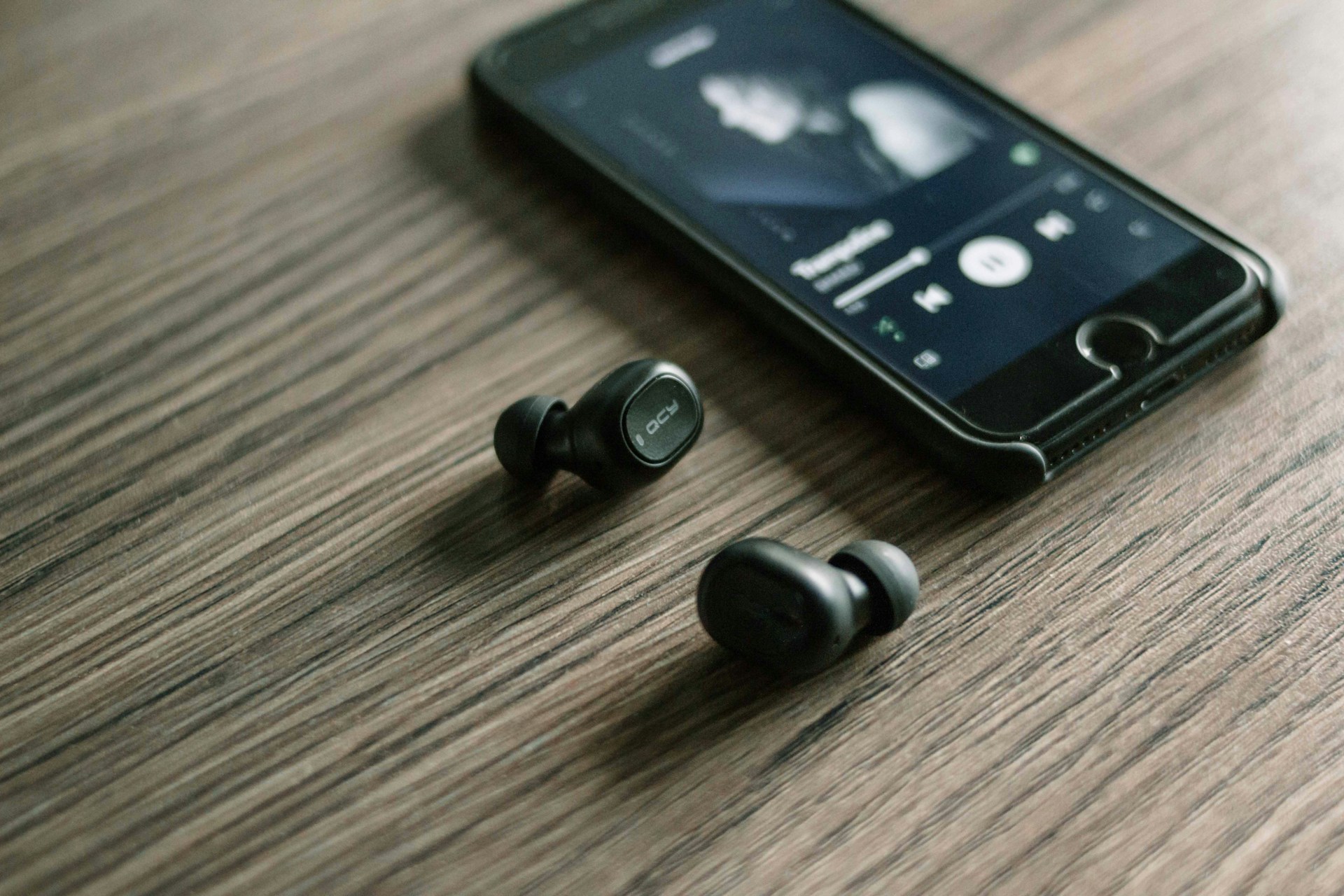
“Are we entitled to all music at all times, or is a personally curated and owned library better for both artist and listener?”
A friend of mine named Josh sent me this question earlier today, and my response to him very quickly got out of hand. So I figured I’d convert my message to him into a blog post. Synergy! (Side note: Josh has a blog of his own which I strongly recommend!)
He did provide the following clarification, as well: “Just because we CAN have access to every artist’s catalog for a small renter’s fee, is it good for us? Is it good for the artist?” He also joked that I would accuse his question of being “a false equivalency or a strawman.” We’ll pick up on my response from there.
It’s less a false equivalency and more of a false binary: presenting these options as if they’re the only two. But I think the question works because it does present the two primary options that we have in our modern day, if we first allow a few presumptions about the audience—chiefly, that we’re talking about people who desire to readily have access to a large amount of music and who are willing to pay at least ten bucks a month for said access.
I’d split the conversation up into three main considerations: convenience, library size, and artist support.
Convenience is the primary factor that sends people flocking to streaming services. Meanwhile, significant convenience issues exist for music-owners: cars and computers no longer being built with CD drives; many artists not selling physical copies of their music; vinyl records that don’t come with digital downloads; etc. These hurdles are, by themselves, enough for many music lovers to desire for a solution which provides more ease and more variety, and it’s hard to say no to Spotify when they’ve done such a good job providing a solution to this convenience issue for well over a decade.
Library size: the biggest perk of streaming services is their so-called access to all of recorded music history. And thus far, it’s seemingly miraculous that all of the big streamers have effectively identical databases; they’ve managed to avoid the pitfalls of movie streaming platforms, where all the good movies have been split between a bunch of services and some movies are constantly bouncing from one streamer to another. This will become a fascinating topic if we ever see specific record labels siding with specific streamers or if we see larger numbers of artists boycotting Spotify. In the meantime, we can ask a different question: What’s better for me as a music lover, having a reasonably large library or having an impossibly large one? More and more in recent years, perceptive listeners have realized that their listening habits have become shallow in the years since adopting streaming. They’ll cite issues such as option paralysis, primarily utilizing music as background noise, rarely listening to the same album more than once, and a decreased amount of time spent giving music deep, thoughtful, critical, and/or lyrical listening. For these listeners, their love of music has been saved by switching back to owned/curated libraries.
Artist support is, I think, the tertiary issue here, at least for most listeners (albeit less so for someone who’d be reading this). I imagine most Spotify subscribers live in blissful ignorance about how little money from their subscription costs actually go to the artists they personally listen to, meanwhile few (if any) streaming platforms are better than Spotify in this regard by any meaningful margin. Deezer* is the only platform I’m aware of that’s currently making strides in the right direction, in terms of giving artists more fair pay alongside taking stands against A.I.-generated music (more on that in a second). Obviously, giving your hypothetical-$10-per-month-musical-allowance directly to a single artist is going to do a lot more for them than the combined payouts to a hundred artists from your streaming subscription. However, for music lovers who are willing and able to budget more money toward music each month, I’ve seen many (myself included) take the middle ground, using streaming services to help them discover artists and sample albums, from which they determine who to support and what to buy.
Weighing these three considerations will illuminate the best course of action to most people, with one vital exception: many of us (who’ve been using streamers for years) don’t meaningfully, viscerally remember what it’s like to listen to music apart from streaming access. These people might want to consider pausing their streaming services for a few months, at the least, to give owning music a shot. What album or set of singles do you want to purchase each month? How easy or difficult is it for you to buy a CD player or to put digital files onto your phone? Do you find joy or angst in dusting off the old record player? Are you finding value in spending extra time with every single album, or do you miss the novelty of always having something new to listen to? Or perhaps are you discovering that you prefer curated playlists over single-artist albums?
There’s not necessarily one right answer because there’s not one type of music fan or one right way to be a music lover. Some people have lost the relationship they used to have with music, back in the days of buying CDs, sitting down in front of the stereo, and reading along to the lyric booklet while listening. Other people never had that relationship with music to begin with and would rather maintain the experience of music as a background comfort.
But what I’m eagerly, worriedly awaiting is how this conversation might change in the years to come. Not only do I expect the three categories above to shift, but I expect a fourth consideration to become increasingly important as well: ownership. What happens when streaming services use A.I. tools to remix or even alter existing songs, potentially without the artists’ permission? What happens when, with increasing frequency, music you love disappears overnight, with no indication of why? And what happens when that disappearing music is due to unwitting artists falsely being accused of bot streaming, plagiarism, or other activity that a streaming service decides they won’t support?
The internet age continues to advance and morph faster than legislators and regulators can keep up with, and there will always be bad actors trying to game the system, whether that’s scammers, “artists,” record labels, or even the streaming platforms themselves. The issues are so complex that, for some, the issue of whether or not to support Spotify is less of a practical one and more of an ethical, moral one. I don’t think that will ever be the case for the majority of users, but for all of us, some self-reflection is worthwhile. Rarely in life is the easiest route the best one.
*A quick word about Deezer. Many casual U.S. listeners may be unfamiliar with the service, which is sizable worldwide but falls outside of the 10 biggest streamers. The French-based company is nearly as old as Spotify, but it ultimately fell far behind its competitors over the past two decades. That said, Deezer has been making headlines lately as one of the most anti-A.I. services. Earlier this year, it began tagging music as “A.I.” whenever it recognizes new submissions with digital watermarks that indicate they were created by generative A.I. services such as Suno or Udio; and Deezer is committed to training its filtering mechanism, so that it can continue identifying those digital watermarks as new services enter the scene and as existing services change. Once a song is tagged as A.I., not only does this indicate the song’s origin to users, but it also makes the song ineligible for editorial playlists or algorithmic recommendations. This is a massive step in the right direction, and I’m hoping other streaming services will follow suit. Deezer is also hoping to make changes to how artists get paid, which I think I’ll save for another day, but I encourage anyone who’s interested to look further into it. This Anthony Fantano interview would be a great resource.
P.S. If you’re still sticking with me, then I invite you to explore a tangent with me. While my response above is nowhere near exhaustive, I want to add that I also believe there’s an entirely different way of responding to the initial question: a “third way,” as it were. As much as I appreciate the strides Deezer is taking toward forging a better way forward for streaming platforms, I have also been thinking for a long time that it might be possible to develop a better type of streaming platform—one that merges standard music streaming with curated ownership.
Nearly a decade ago, I conceived of an alternate type of streamer, where the focus would be on “purchasing” access to albums instead of immediately having access to all music. Users would still have unlimited access to a small subset of all available music, but it would be a small fraction—something like one song per album or only the most recent few singles from every artist. Financially speaking, the idea goes something like this: You’d pay $6 per month, and of that, $2 would go to the platform, $1 would be used to pay for the music you streamed from the widely available pool, and $3 would function as a “credit” toward adding one new album into your own personal library. Thus, month by month, you would slowly be building your own collection of albums to stream (with the option of paying extra to add more than one album per month). You could also save up monthly credits in order to purchase access to larger collections, compilations, or curated playlists, or you could hold on to your credit if you want to wait to decide what to buy next.
There are a few obvious flaws with this idea. Namely, the platform’s value would be heavily dependent on surviving as a long-term business (going up against unbeatable competition) and ensuring that albums which have been “purchased” by users are never removed from availability. But overall, I view this concept as a win-win for artists and for users: Artists or their rights holders would receive the full $3 per “purchase” alongside standard per-stream revenue from songs on playlists. (For reference, on most streaming platforms, you would need to stream an artist nearly 1,000 times before you would single-handedly earn three full dollars for them.) Meanwhile, users would get to enjoy a cheaper platform which encourages them to spend more time with each album, trading in overwhelming option paralysis for personal, intentional curation.
The other glaring issue with my proposal is that users’ collections would be pretty bleak in the early days of subscribing, but I have a solution for that, too. In an ideal scenario, this platform would simultaneously function as a streamer, as a music store (i.e., iTunes, Amazon Music), and as a media player for locally-owned music files. This way, users could have access to their Bandcamp purchases or their ripped CDs from their very first month. This is no novel idea—even Spotify has the ability to play local files—but what’s unique about my idea is the interplay between the streaming service and the music store. In my conception, you would be able to truly buy and download digital albums from the platform alongside “buying” access to them with your monthly credit; the big kicker here is, if you use your $3 credit to gain streaming access to the album first, then decide later that you want to own it outright, you’ll get a $3 discount on the purchase price.
This, in my mind, is one of the core failures of music-stores-turned-streaming-platforms like iTunes and Amazon. Apple Music offers a solid integration between the music you own on your computer and the streaming music you save or download, but it lacks any financial incentives for streaming subscribers to also buy music from its store. What if Apple Music’s paid subscribers were offered a $1 discount on all albums? Or what if your streams of an album created a personalized discount toward purchasing that album—as in, once you’d accumulated 1,000 song streams of a specific album, you’d get $3 off buying it? I highly doubt Amazon or Apple will ever move in this direction, but doing so would mark a big step toward better supporting both artists and their fans.
Personally, I find the ideas here to be exciting and nearly endless. I don’t want to go on forever, but another big possibility would be creating a back-end platform for artists (akin to Spotify for Artists) where they could provide even better offers to fans (e.g., exclusive announcements, special pre-orders and discounts, or pre-sale concert tickets to users who’ve bought one of their albums on the service). Artists could also use the back-end platform to select which of their songs are available for “free” and to pitch those songs for inclusion on additional curated playlists. This back-end platform could also be utilized for artist verification, in order to prioritize the artists who’ve proven that they are real humans and active musicians, favoring them over legacy artists, defunct acts, fake projects, and A.I. music. (Granted, I’d prefer to keep A.I. music off the platform in general, but I imagine doing so in years to come will grow increasingly difficult.) This would create a culture where the artists most likely to be streamed and supported through the platform are the musicians who are presently trying to make their living off of music.
I’ll stop there before my “P.S.” becomes longer than the actual article it’s attached to… but either way, thanks for reading, and hit me up on socials, in the Friends Club, or via email if you have any feedback, questions, push-back, ideas, whatever! I’d love to hear from you.
(Featured image by Zarak Khan on Unsplash)